


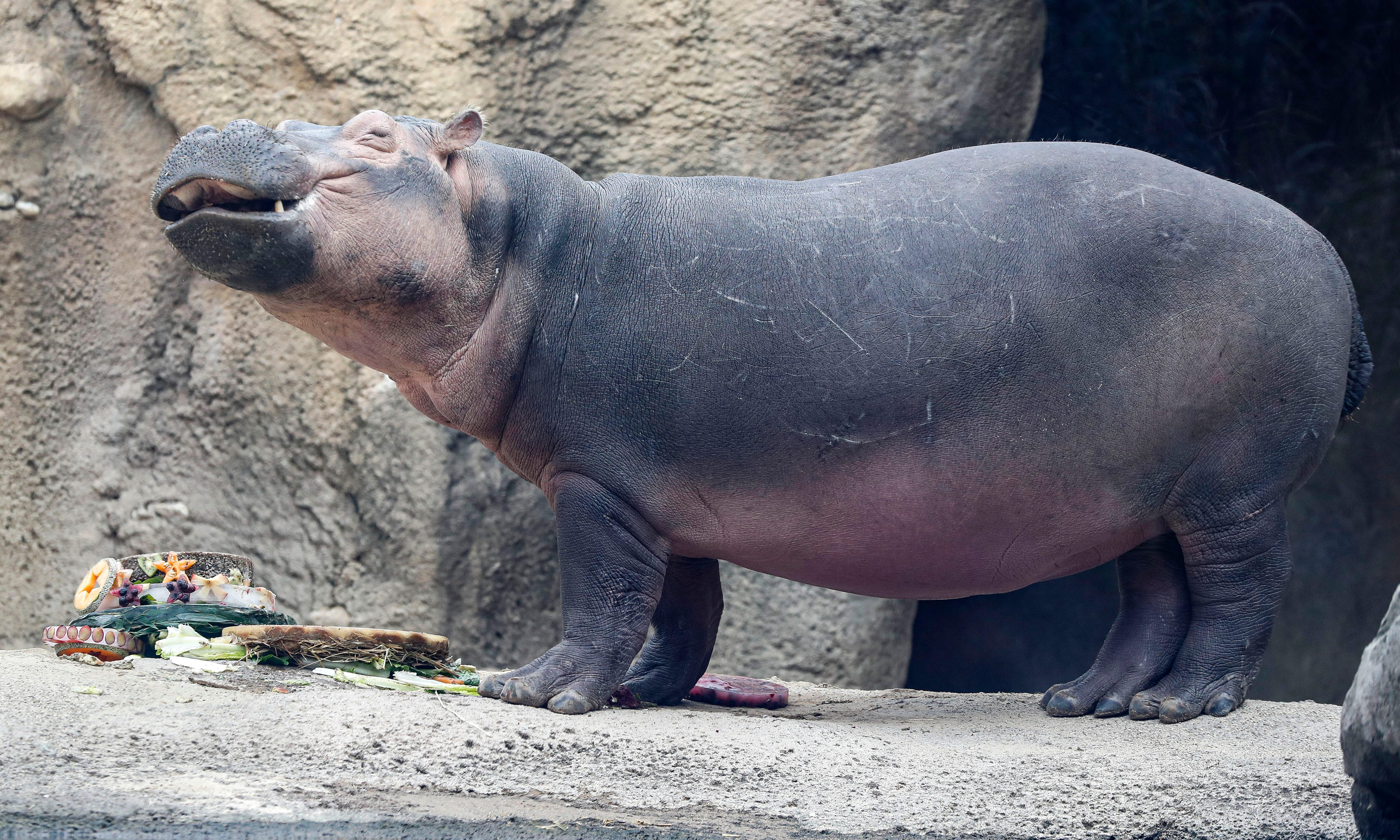
Almost a decade ago, Fiona the Hippo received global love for her fight to survive following a premature birth. Today, at just 9 years old, she’s dead. She passed away on Thursday (Nov. 9) after swallowing a hat that fell into her enclosure. One day after her passing, the Cincinnati Zoo shared more details about the animal’s cause of death.
RELATED: Social Media Reacts To Endangered Gorilla Shot Dead After Boy Falls Into the Cincinnati Zoo Exhibit
Fiona The Hippo Died From The Blockage
A necropsy on Fiona the hippo showed that the hat she swallowed nearly two weeks ago was caught in the middle of her small intestine. That’s what ultimately led to her passing amid attempts to locate the blockage. In a statement, Cincinnati Zoo explained that the hat was too far into her digestive system, which left no supportive care options that could’ve saved her life.
At first, Fiona showed no signs of distress after swallowing the hat 11 days before her death. A minor zoo visitor tossed the hat, which a ceiling fan caught and flung into the hippo habitat. But a few days later, her appetite started to decline, zoo officials said. By Monday (Nov. 16), the zoo announced Fiona was undergoing veterinary care. Officials were cautiously optimistic she could pass the hat. The zoo’s animal care team gave her fluids through an IV, conducted a colonoscopy, and tried to shake the obstruction loose with a vibration table borrowed from a horse farm. None of it worked.
Stay Connected
Subscribe to updates from The Shade Room
What Other Efforts Did Cincinnati Zoo Make To Save The Hippo?
Unlike the watermelons and pumpkins she easily loved, Fiona’s digestive system wasn’t meant to break down synthetic fibers, experts said. Hippos have a multichambered stomach for digesting plants and a very large gastrointestinal tract that swallowed material must pass through.
Blood work showed her health was failing Thursday. In response, the zoo’s animal care team tried to locate the hat using a scope and an ultrasound, according to Mike Wenninger, the zoo’s director of animal health. Removing the hat surgically was impossible based on its location and the hippo’s anatomy, he added. Fiona died during recovery from the procedure, he said.
The necropsy found the hat was 25 feet beyond her final stomach compartment and 50 feet from the end of her intestines.
“No treatment aside from supportive care had any chance for success, and the necropsy confirmed that no amount of supportive care would have worked,” Wenninger said.
Fans & Zoo Staff Are Mourning Fiona’s Death
Since her death, Fiona’s fans have covered a hippo statue at the zoo with flowers and notes written in crayon. Others left behind watermelons and pumpkins, some of her favorite treats.
“She brought so much love in her lifetime,” said one note.
Jessica Grieshop often brought her daughters to see Fiona. During her visit to the zoo Friday morning, she called the hippo an inspiration for “anyone that was going through hard times.”
Meanwhile, Cincinnati Zoo director Dave Jenike opened up about Fiona the hippo’s passing and how fans will remember her.
“The support that we’re feeling from all over the world reminds me of the time when everyone pulled together to root for her to survive,” said Jenike. “She did, and she gave us almost a decade of smiles.”
One of Fiona’s keepers, Jenna Wingate, posted a heartbreaking message on Instagram, saying it was like losing a family member.
“It has always felt like we grew up together, and I often used to smile thinking about growing old with her and her still being around when I retire,” Wingate wrote. “We lost her in the most horrific and tragic way.” She ended: “She was our family. I love you Fiona and I am so sorry.”
Fiona wasn’t the first hippo to die at the zoo after ingesting a foreign object. In 1923, a hippo “came to an untimely death due to a small boy who threw a rubber ball into its mouth,” according to records at the Field Museum in Chicago. That museum confirmed on Friday that it received the remains of the 1923 hippo from the Cincinnati Zoo.
Associated Press writers Obed Lamy, John Seewer and Holly Ramer contributed to this report via AP Newsroom.
