

The Role of the US Government Debt in World Capital Movements
The article examines the impact of US government debt on international capital flows. The main stages of the development of the US government debt, the structure of the US Treasury government bond market, the structure of government debt holders are considered. The 2011 US debt crisis and its impact on the world economy are considered separately. Based on statistical information, a brief analysis of trends in the US public debt and the prospects for its development is given.
Introduction
The history of the United States is a history of constant growth in foreign trade, government spending, and an increase in government debt. In fact, both US citizens and the US government have been living in debt for several decades. However, in the entire history of the United States, the federal authorities of the country have never refused to fulfill their debt obligations and have never declared a moratorium on the payment of interest on debt.
Over the past 20 years, the United States has become the world's largest debtor. Since 1940, the US population has increased by about 100%. During the same time, the US national debt increased by 12,043% or 120.5 times. The US debt is increasing every second by about $ 14.5 thousand. [1] Starting September 30, when the costs of the war in Iraq, as well as the country's internal economic situation, made themselves felt, the national debt began to grow by an average of $ 2 billion per day.
The relevance of this work is due to the need to analyze the US debt crisis and search for solutions to the existing economic problems. As we can see, the rating of brokers in the United States is constantly changing and requires close attention. The United States is a major economic, monetary and financial center of the world, which can absorb a technical default, or rather a flow of external debt. The United States has uniquely ensured that its domestic economic problems have an impact on the global economy. In cases of default, the United States jeopardizes the interests of international creditors, since the dollar is the world's reserve currency, the economies of all countries will suffer. The problem of the daily increase in the US national debt requires an immediate solution by the government of the country, otherwise they may irrevocably lose the confidence of world markets in the US creditworthiness and this will undermine the special status of the dollar as a single reserve currency. Economic observers are closely following the development of the debt crisis and predicting its consequences.
This work is structurally divided into four chapters. The first chapter gives a retrospective view of the American public debt, examines the key stages of its development, and describes the crises of the U.S. public debt, excluding the last crisis of 2011. In the second chapter, we will show what the U.S. public debt is, who are its main owners and which countries are the largest US lenders. The third chapter examines the role of the US government debt in the world economy. The fourth chapter will provide a brief analysis of the prospects for the development of the US public debt, in particular, the debt crisis of August 2011 and the measures of the US Federal Government to overcome the crisis and further regulate the public debt.
History of the US national debt
"The US debt, external and internal, -
it is the price of American freedom. "
Alexander Hamilton
The emergence of public debt
For the first time, the US national debt was recorded on January 1, 1790 and was equal to $ 52,788,722.03. It consisted of debt from the Continental Congress and $ 191,608.81 borrowed by Treasury Secretary Alexander Hamilton from New York banks to cover the expenses of the new government. [2] Figure 1 shows the evolution of the value of the US government debt in relation to GDP.
Then the national debt increased as a result of the War of Independence and on January 1, 1791, the Article of Confederation and Perpetual Union, the first constitutional document of the United States, was set at $ 75,463,476.52, or $ 1.75 billion in 2010 dollars [3] This meant that every American owed $ 350. From 1796 to 1811 the United States recorded fourteen budget surpluses and two deficits. The national debt rose sharply in 1812, as a result of significant spending on the Anglo-American War, but as a result of eighteen budget surpluses over the next twenty years, the United States was able to pay off 99.97% of its debt.
Another sharp increase in debt fell on the Civil War. From 1860 to 1863 it increased almost 20 times from $ 65 million to $ 1 billion, and by the end of the war the national debt was $ 2.7 billion. Thirty-six budget surpluses and eleven deficits in the next forty-seven years made it possible to cover about 55% of the debt.
World War I and the Great Depression
A new surge in US government debt was caused by the First World War and huge military spending: the debt increased to $ 27 billion. In the next decade, the US federal budget was in surplus, which made it possible to significantly reduce the amount of debt. From 1920 to 1930, the US debt was reduced by 38.2% to $ 16.2 billion. And in the next few years, the debt amounted to no more than 5% of the country's GDP.
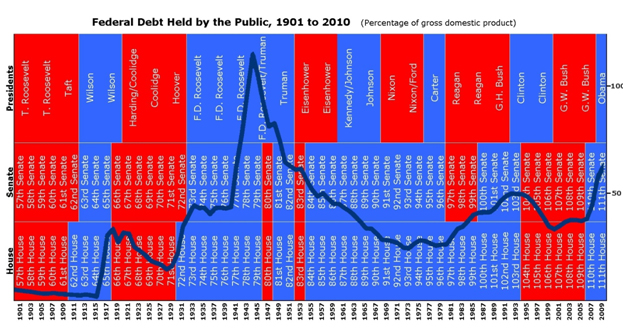
In 1932, President Herbert Hoover balanced the budget and cut government spending, which, incidentally, accelerated the pace of economic decline, which was experiencing an unprecedented crisis in US history - the Great Depression. His successor, President Roosevelt, began to tackle the crisis through sweeping reforms to reduce unemployment and poverty. Despite the fact that he managed to bring the US economy out of the crisis, his policies caused a significant increase in the budget deficit. The debt of the American state increased to almost $ 43 billion.The Second World War and colossal military expenditures dealt an even stronger blow to the American budget: in 1945, the US national debt was already $ 258.7 billion.
In the 1980s, under the rule of President Ronald Reagan, the country's national debt for the first time rose sharply, not due to external reasons, but as a result of ill-conceived financial policies. Reagan carried out a major tax cut, while, however, government spending did not decrease, but, on the contrary, increased, which caused the government debt to triple. In 1990, it reached $ 3 trillion, 233 billion.
2000s
From 1992 to 2000, the US economy experienced a period of economic recovery. However, the collapse of Internet companies and the terrorist attacks of September 11, 2001 were one of the many reasons for the start of a sharp downturn in the country's economy. According to the Heritage Foundation, 2000-2003 was a record for the United States in terms of budget expenditures. [4] For each American family, the US administration spent $ 73,273 (all types of government spending are taken into account). Large spending was recorded in the United States only during the Second World War. Between 2001 and 2003 alone, US spending grew 16%. The US national debt has grown due to a significant increase in defense and security spending, as well as military operations in Afghanistan and Iraq. As a result, in 2002 the US national debt reached $ 6 trillion. 228 billion
Public debt structure
What is the US national debt?
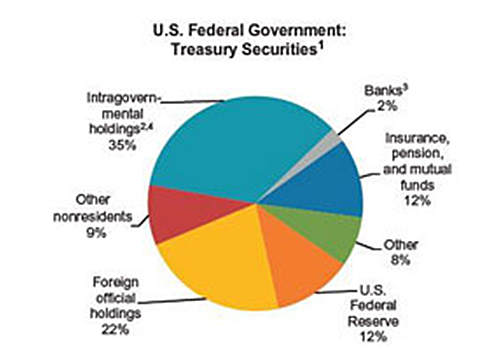
The US Treasury Department lends money overseas and domestically through the sale of Treasury bills, bonds, and other securities. A significant portion of the US government debt is US Treasury securities (U.S. Treasury securities), which are classified into 4 types, depending on the maturity:
Short-term Treasury Bills (Bills) - up to 1 year
Medium Term Treasury Notes (Notes) - 1 to 10 years
Long-term Treasury bonds (Bonds) - over 10 years
Treasury Inflation-Protected Securities (TIPS) - 5, 10 and 30 years
In recent years, there has been a clear bias towards short-term obligations (bills) versus long-term (bonds). This structure of debt (mainly short-term liabilities) is beneficial to the United States, since it significantly reduces the cost of maintaining debt. At the same time, there is a high risk of insufficient demand for debt securities with extremely low yields. [5]
It is worth noting that the US government debt does not include debts of individual states, corporations or individuals, even those guaranteed by the state, as well as money belonging to future social assistance recipients.
Holders of public debt
Holders of the US public debt can be divided into two groups:
non-state creditors (public debt), which includes investors (private and institutional), the Federal Reserve System (US Central Bank) and foreign governments
US government funds (intragovernment debt), such as social security fund, health insurance fund, etc.
The US debt crisis of 2011
One of the key and most important features of American life is life on credit. At the end of last year, US consumers owed more than $ 2.4 trillion in debt, according to the US Federal Reserve. The average American has home loans, car loans, student loans, home appliance loans, and so on, but the fastest growing component of debt remains credit card debt. The history of credit cards dates back to 1914, but they did not reach their full bloom until 1958. This means that most Americans today, including politicians, were born and raised in a society where borrowing money is easy, simple and enjoyable. And given that it is relatively easy for an individual in the United States to declare bankruptcy, most do not even think about how to return the loans received.
The external debt of the United States has reached more than $ 14 trillion over the past 10 years, having more than tripled.
According to the US Treasury Department, America's external debt now stands at 94% of GDP. Since President Barack Obama came to power in January 2009, the US external debt has grown by $ 2.4 trillion. Over the entire period of George W. Bush's rule, this figure has grown by $ 4.9 trillion. [6]
A feature of the debt crisis in the United States is the inability of an entire state to pay off its debts.
The US government is the largest debt-ridden consumer that has borrowed from lenders around the world to cover 43% of its spending this year. And this is Washington's largest loan since WWII. But the United States is unique: because of its sheer size, it cannot be considered an ordinary borrower. Take the fact that if the US does not meet its debt obligations (like Greece or Ireland), financial chaos could break out in such a way that the 2008 crisis will seem insignificant. In addition, with the dollar long considered the reserve currency among global investors, Washington can always print more dollars to reassure it that it can pay its bills. No other borrower can afford this luxury.
Unique US privileges provide them with large airbags. But these pillows also hide the depth of the problem and allow Washington to keep piling up debt rather than breaking the habit. For example, the rapidly expanding national debt, now over $ 14 trillion, may soon surpass the overall size of the entire US economy. The US now spends less of the budget on interest payments than it did before, but that's because interest rates are unusually low. Paying interest on the national debt this year will cost taxpayers $ 210 billion, less than payments between 1995 and 2000. Interest spending is 5.4% of all federal spending this year, up from 12.5% in 2000. And this is one of the reasons why politicians may talk a lot about US debt but not really do anything.
The "snowball" of debt continues to roll over America. By the end of this year, it is necessary to repay $ 1.825 trillion, by June 2012 - 2.610 trillion, in 3 years - 4.839 trillion!
Along with the inflationary spiral, a second spiral is unfolding: debt. Debt grows - it hits the bar - government spending decreases - a threat to economic growth - debt rises again. And along with it, and the cost of its maintenance. Moreover, an interesting picture can be observed: in 2006, interest payments on debts amounted to about 10% of the budget. For 5 years, the indicator practically did not change, even decreased - to 8.2%. But by what means? By reducing rates from 5% in 2006 - to zero in 2011, and nothing more.
Published at the end of July, another portion of macroeconomic statistics on the United States once again confirmed the validity of experts' suspicions about the growing decline in the level of economic and investment activity, as well as the contraction of industrial production. According to the results of 1 quarter. 2011 the annual growth of the American GDP barely exceeded the 1.9% mark, which is extremely low and insufficient to maintain the creditworthiness of the United States as a borrower. At the same time, the recent decline in the level of economic activity is even more worrying. If in 4 sq. 2009 the annual GDP growth exceeded 5%, then in the 4th quarter. 2010 the dynamics of added value creation decreased to 3.1%
Along with government debt, estimated at $ 14.5 trillion, there is also household debt ($ 13.3 trillion), corporate debt ($ 10.9 trillion), and debt of financial institutions ($ 14.1 trillion). In total, the total debt of all subjects of the US economy exceeds $ 53 trillion, which is more than 355% of the GDP of the largest economy in the world.
If the amount of external debt is not reduced, then a technical default is possible, which could lead to a catastrophe for the world economy. A technical default is a failure to fulfill obligations without formal bankruptcy, a situation when a borrower has violated a loan agreement, but physically he can fulfill this agreement.
Impact of the US public debt on the world economy
In the global economy, the United States dominates in the main economic indicators, being the leader:
- Largest economy
- Largest sales market
- Largest investor
- Largest debtor
As long as the US dollar remains the world's reserve currency, American economic problems will affect the entire global economy. It is impossible to get rid of the savings of states accumulated in the American currency at once. And in the event of a technical default by the
United States, the following consequences may arise for the economies of other countries:
- capital outflow from developing countries (including Russia) due to lower investment,
- acceleration of inflation due to the withdrawal of a large amount of money into cash circulation,
- depreciation of national currencies,
- reduction of wages,
- falling property prices,
- growth of interest rates on deposits up to 200%.
The US debt crisis was a warning sign for China, the largest foreign holder of US government bonds. China faced many difficult issues, including a reduction in foreign currency assets, export trade was negatively affected, and pressure from imported inflation increased. Analysts note that with the slow recovery of the US economy, over the next few years, Chinese import and export enterprises may face weak external demand, a higher exchange rate, and an unfavorable environment due to persistent international trade friction. The export trade of China, the world's largest exporter, is bound to be negatively impacted. Industry experts note that since the dollar is the most important settlement currency in the world, the "new dollar printing" caused by the US debt crisis led to the devaluation of the US currency, which caused the rise in prices for consumer goods in dollars. Thus, the pressure increased with imported inflation in China, a major importer of raw materials.
The US debt crisis was a warning signal to China that it must stop accumulating its already huge reserves of foreign exchange and be wary of the threats to national security and national finances posed by excessive dollar assets.
The debt crisis does not have a direct impact on European countries, since their savings are denominated in euros. The negative impact is due to the deterioration of world trade turnover, surges in oil and securities prices. Although the debt crisis in Europe contributed to the economic instability of the United States. These are two large economic and financial centers that influence the economies of each other and the world.
The problems of the US banking sector are hampering lending around the world and undermining the global economy. This, in turn, is detrimental to Latvia, since the Latvian economy is based mainly on exports and a drop in demand from the main trading partners, with limited business financing by banks, will also mean a reduction in orders from Latvian manufacturers.
The US debt crisis does not allow the stock market to function normally, provoking another crash. So in early August 2011, Standard & Poor's for the first time in modern history lowered America's highest rating to AA amid fears related to the country's growing budget deficit. This decision caused a sharp collapse in the stock and commodity markets; convulsive ups and downs continued for another week.
The indices of the Russian stock exchanges fell following the global ones, having lost 0.2% at the end of the main trading. bad data from the US also affected Asian markets, which eventually closed in the red. The leading indices lost 1.3-1.6%. Asia also has its own concerns - deterioration in business activity in China and the expectation that the Chinese authorities will raise lending rates. Bad news from Europe also added pessimism to trading in Asia. Moody's agency has downgraded Greece's credit rating by three notches at once - from B1 to Caa1. For this reason, European indices are losing within 1%.
The US debt crisis poses a real dilemma for overseas creditors. They must either take the colossal and direct financial risk associated with a US default, or buy additional US bonds at risk. The US can take advantage of the possibility of a debt default to threaten other countries. This is the terrible systemic risk inherent in the current international financial system.
At the same time, the US debt crisis was a warning signal for large foreign holders of US government bonds. They must stop accumulating their already huge reserves of foreign exchange and be wary of the threats to national security and national finances posed by excessive dollar assets.
In the post-global financial crisis era, there is growing consensus that the dollar-based international exchange system needs to be reformed as soon as possible. Getting rid of the dollar not only serves the interests of the creditor countries, but also ensures the stability and reliability of the global financial system.
